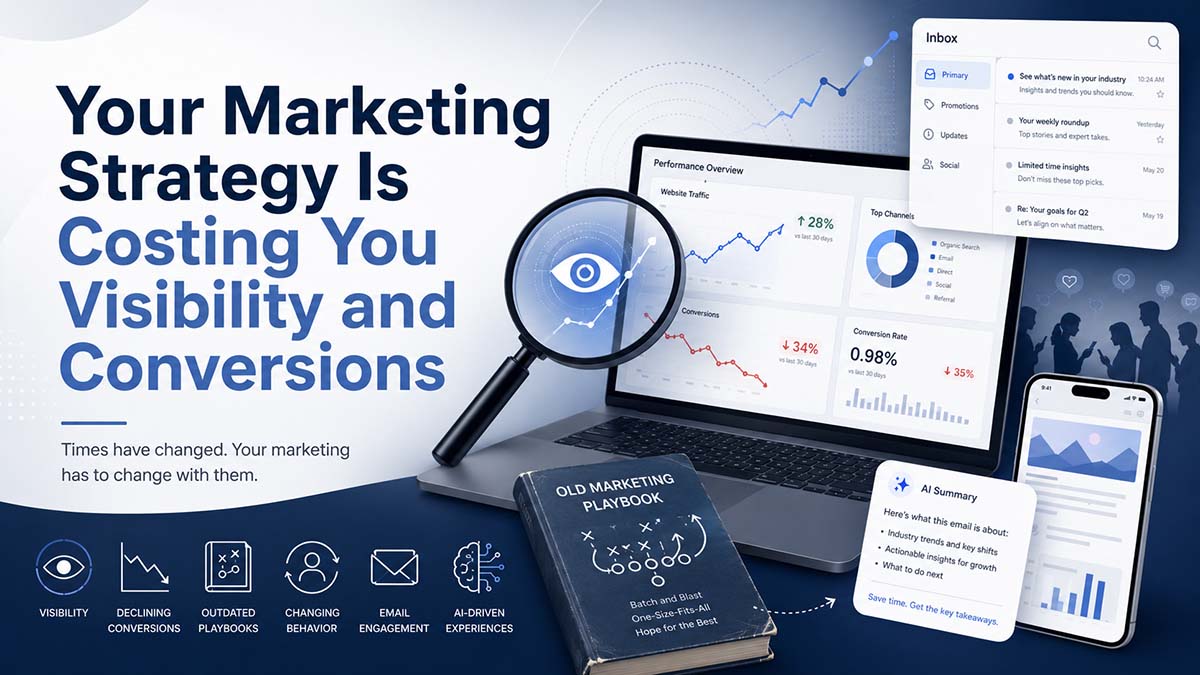
Your Marketing Strategy Is Costing You Visibility and Conversions
Times have changed. Your marketing has to change with them.
The Direct Answer
If your conversions, clicks, engagement, or profits are declining, the problem may not be that your marketing stopped working.
The bigger problem may be that your marketing was built for a version of your customer that no longer exists.
The way people consume information has changed.
The inbox has changed.
Technology has changed.
Customer expectations have changed.
But many businesses are still operating from marketing playbooks written five or ten years ago.
Then they wonder why the same tactics are producing weaker results.
Before you spend more money generating traffic, leads, or subscribers, there is a more important question to ask:
Can people still see, understand, and act on the marketing you already have?
Your Customer Did Not Stop Paying Attention
You have probably heard some version of the claim that people now have an eight-second attention span.
I would not build your marketing strategy around that statistic.
The reality is more complicated.
People can still spend hours watching a movie, listening to a podcast, researching a purchase, watching YouTube, or consuming content they genuinely care about.
The problem is not that people are incapable of paying attention.
They have become much more selective about what deserves their attention.
That distinction matters.
Research from Nielsen Norman Group has repeatedly shown that people tend to scan digital content rather than read every word from beginning to end.
Read Nielsen Norman Group’s research on how people read online
Their eye-tracking research has also identified several common scanning patterns people use when viewing websites and digital content.
Review the eye-tracking research
At the same time, your customer is operating in an environment filled with emails, texts, notifications, social media, meetings, apps, and other demands for their attention.
Microsoft reported that among the 20% of users receiving the highest volume of workplace notifications, interruptions from meetings, emails, or chats occurred at an average rate equivalent to approximately once every two minutes during core working hours.
Read Microsoft’s research on the modern workday
Your customer is not patiently waiting for you to explain why they should care.
They are deciding whether they care while they are reading.
And if your marketing makes them work too hard to understand the point, you may lose them before you ever get to the offer.
The Inbox Is No Longer Just an Inbox
Email is one of the clearest examples of how dramatically the marketing environment has changed.
For years, marketers thought about email using a relatively simple path:
Delivered → Opened → Read → Clicked
That model is increasingly incomplete.
Mailbox providers are becoming more active in how information is filtered, prioritized, presented, and summarized for users.
In January 2026, Google announced additional Gemini-powered features for Gmail, including AI-generated thread summaries, AI Overviews for inbox questions, and an AI Inbox experience designed to help surface messages and topics that may matter most to the user.
Read Google’s Gmail announcement
Gemini in Gmail can also summarize email threads and help users find information contained inside previous messages.
Review Google’s Gemini in Gmail documentation
Think about what that means for marketers.
You are no longer writing only for someone who will necessarily open your email, read it from top to bottom, and then decide whether to click.
Your message now exists inside an environment where software may help determine what appears important, what gets surfaced, and how information is summarized.
Yet plenty of companies are still writing email exactly the way they did five or ten years ago.
Long introductions.
Huge blocks of text.
Important information buried halfway through the message.
Multiple competing calls to action.
Subject lines that try to be clever instead of telling the reader why the message matters.
The customer changed.
The inbox changed.
The marketing didn’t.
Deliverability Is Only Half the Battle
This is where marketers also need to separate deliverability from visibility.
Deliverability asks:
Did the mailbox provider accept your email?
Visibility asks:
Did your message actually earn an opportunity to be noticed, understood, and acted on?
Those are not the same thing.
Strong email marketing now requires thinking about both.
Google’s email sender guidelines make it clear that authentication, spam complaint management, unsubscribe functionality, and other technical requirements matter when sending to Gmail users.
Review Google’s Email Sender Guidelines
But technically delivering your email does not automatically make the content effective.
You can successfully reach someone’s mailbox and still fail to communicate.
That distinction is becoming increasingly important.
A business can look at its email platform, see that the messages were “delivered,” and assume everything is working.
Meanwhile:
People are not clicking.
People are not replying.
People are not buying.
People are not taking the next step.
At that point, you may not have a traditional deliverability problem.
You may have a visibility and conversion problem.
Your Website Has the Same Problem
This is not limited to email.
Look at many websites and landing pages and you will still find the same basic marketing structure companies have used for years.
A giant headline.
Several paragraphs explaining the company.
A long list of features.
Some testimonials.
Another paragraph.
Then eventually, a form or call to action.
The page assumes the visitor will patiently consume the argument from beginning to end.
That is a dangerous assumption.
People scan.
They jump between headings.
They look for the information relevant to the decision they are trying to make.
They skip sections.
They look for proof.
They look for price.
They look for the next step.
Your marketing message has to survive being scanned.
A visitor should be able to quickly answer four questions:
What is this?
Is it for me?
Why should I care?
What should I do next?
If someone needs to read hundreds of words before they can answer those questions, your problem may not be your traffic.
Your problem may be your marketing.
Stop Blaming the Funnel Before Examining the Message
This is where businesses frequently make an expensive mistake.
Conversions fall, so they buy more traffic.
Engagement falls, so they send more email.
Appointments fall, so they add another automation.
Sales fall, so they build another funnel.
More marketing does not automatically solve outdated marketing.
Sometimes it simply sends more people through a system that is already losing them.
Before adding another campaign, start asking harder questions.
Can someone understand your message quickly?
Could someone scan the first section of your landing page and understand exactly what you are offering?
Does your email communicate the important point early?
Or does the reader have to work through several paragraphs before discovering why you contacted them?
Does every message have one clear purpose?
Or are you asking the recipient to read an article, watch a video, follow you on social media, book a call, buy something, and download a resource all in the same email?
Are you measuring the right behaviors?
Are you relying on the same engagement signals and assumptions you used years ago?
Does your funnel respond to current customer behavior?
Or was it designed around assumptions that nobody has questioned in years?
And perhaps most importantly:
Are you making it easy for someone to understand and act, or are you making them work for it?
The New Marketing Advantage Is Clarity
Marketing has become incredibly complicated.
More automation.
More segmentation.
More funnels.
More platforms.
More analytics.
More AI.
More content.
More data.
Those tools can be valuable.
But complexity is not the same thing as effectiveness.
In a crowded environment, clarity becomes a competitive advantage.
Your subject line should give someone a reason to investigate the message.
Your opening sentence should establish why the message matters.
Your landing page should allow someone to understand the offer without studying it.
Your content should be structured so someone can scan it and still understand the argument.
Your call to action should make the next step obvious.
Your funnel should make it easy for people to move forward.
And your marketing strategy should be designed around how customers behave today, not how they behaved in 2018.
This Is Not About Chasing Every New Marketing Trend
None of this means you need to completely redesign your marketing every time Google, Apple, Microsoft, or another technology company releases a new feature.
That would be ridiculous.
The lesson is much simpler.
Marketing has to evolve when customer behavior and the technology surrounding that behavior evolve.
The companies that recognize those changes early have an advantage.
The companies that continue running the same playbook eventually start asking:
“Why doesn’t this work like it used to?”
Sometimes the answer is uncomfortable.
Nothing is necessarily broken.
The world around your marketing changed.
And your marketing didn’t.
The Question Every Business Should Be Asking
Do not start by asking:
“How do we send more email?”
“How do we get more traffic?”
“How do we create more content?”
“How do we build another funnel?”
Start here instead:
Can people still see, understand, and act on the marketing we already have?
Because if the answer is no, adding more marketing is unlikely to solve the underlying problem.
Before you build another funnel, launch another campaign, increase your ad budget, or send more email, take a hard look at what happens once someone enters your marketing ecosystem.
Can they understand you?
Can they find the important information?
Can they quickly determine why they should care?
Is the next step obvious?
Does your marketing match the way people consume information now?
Because your next growth opportunity might not come from reaching more people.
It might come from becoming more visible to the people you are already reaching.
How Visible Is Your Marketing?
Want to see where your marketing or email strategy may be losing visibility?
Setup a free analysis of your visibility and consultation with us.
Find out what may be getting between your message and your customer.
Resources
Nielsen Norman Group: How People Read Online
https://www.nngroup.com/articles/how-people-read-online/
Nielsen Norman Group: Text Scanning Patterns: Eyetracking Evidence
https://www.nngroup.com/articles/text-scanning-patterns-eyetracking/
Microsoft WorkLab: Breaking Down the Infinite Workday
https://www.microsoft.com/en-us/worklab/work-trend-index/breaking-down-infinite-workday
Google: Gmail Is Entering the Gemini Era
https://blog.google/products-and-platforms/products/gmail/gmail-is-entering-the-gemini-era/
Google Gmail Help: Collaborate with Gemini in Gmail
https://support.google.com/mail/answer/14355636?co=GENIE.Platform%3DDesktop&hl=en
Google Gmail Help: Email Sender Guidelines
https://support.google.com/a/answer/81126